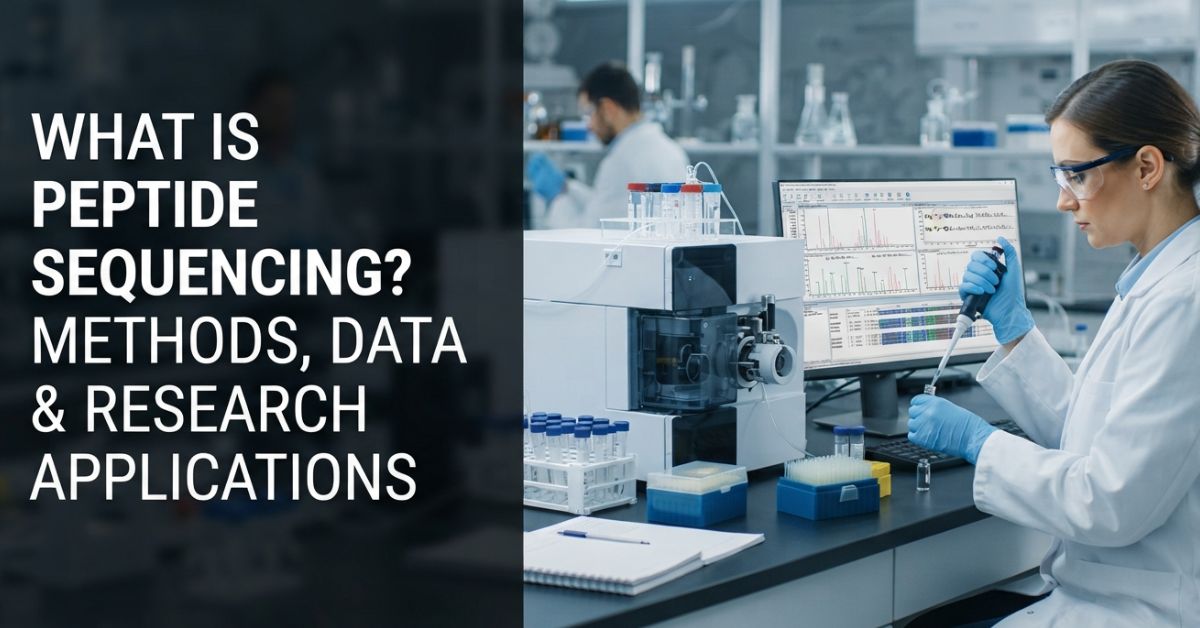
A peptide may be present in a sample, but researchers still need a way to determine which amino acids make it up and the order in which they appear. That order can provide important information about the material being examined and whether it matches an expected sequence.
Understanding what peptide sequencing is starts with this basic purpose. Researchers use analytical techniques to determine or confirm amino acid order, compare an observed peptide with reference information, and investigate differences that appear in laboratory data.
What Is Peptide Sequencing and What Does It Reveal?
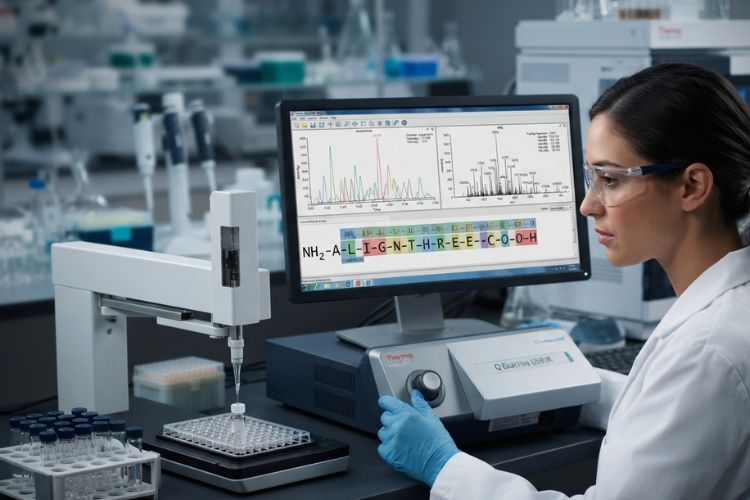
In simple terms, what is peptide sequencing? It is the process of determining the order of amino acids within a peptide. Since peptides are chains of amino acids joined by peptide bonds, identifying their sequence gives researchers a more detailed view of the molecule they are studying.
Sequencing is not quite the same as identifying a peptide by name. Amino acid sequence analysis looks at the order supported by experimental evidence. That sequence can then be compared with an expected peptide, a known protein, or information stored in a reference database.
What Information Can Researchers Get From a Sequence?
The final sequence is only one part of the result. Peptide sequence analysis can help researchers compare expected and observed material while identifying areas that may need closer investigation.
Several details can be examined during this process:
- Amino acid order: Fragment data can provide evidence for where individual amino acids occur within a peptide.
- Sequence variations: Unexpected substitutions or differences may become visible when experimental data are compared with a reference.
- Possible modifications: Changes in measured mass can suggest chemical or post-translational modifications, although further evidence may be needed to confirm their location.
- Sequence confidence: Researchers can review how much of a proposed sequence is supported by the available fragment data.
- Structural evidence: Peptide structure identification uses sequence information alongside other analytical findings to support characterization of the sample.
Peptide Sequencing Methods Do Not All Read a Sample the Same Way
Different peptide sequencing methods are available because not every research sample presents the same problem. A known purified peptide may require a different approach from an unknown peptide found in a complex biological sample.
Mass Spectrometry and MS/MS
Mass spectrometry looks at the mass-to-charge ratio of ionized molecules in a sample. With tandem mass spectrometry, or MS/MS, a peptide ion is selected and broken into smaller fragments. Researchers then look at the masses of those fragments to work out which amino acids may be present and where they sit in the sequence.
During amino acid sequence analysis, the mass difference between one fragment and the next can be matched with the mass of a particular amino acid residue. Software makes it easier to sort through a large amount of spectral data, but it does not remove the need to check the results. Missing fragments or a weak spectrum can leave parts of the sequence less certain.
Database Searching and De Novo Sequencing
Database searching is useful when researchers already have some idea of what may be in the sample. The measured spectrum is compared with predicted spectra from known peptide or protein sequences. If a good reference is available, this can help narrow down which known sequence best matches the sample.
The situation is different when the peptide is unknown or no suitable database match appears. De novo sequencing works directly from the MS/MS fragments to piece together the amino acid order. This is one way to understand what is peptide sequencing when there is no known sequence available to use as a starting point.
Edman Degradation
Edman degradation takes a residue-by-residue approach. Amino acids are removed and identified one at a time, starting from the peptide’s N-terminus. It is not used for every sequencing job, but it still has a place when researchers are working with a purified peptide or need to check its N-terminal sequence.
The condition of the sample matters here too. A sample that contains several peptide species or other material can be harder to work with than a clean one. Looking at How Peptide Purity Is Measured can help researchers understand what a reported purity result means and why it matters when reviewing peptide data.
Why Peptide Sequencing Data Can Be Difficult to Interpret
An MS/MS instrument does not simply display a finished amino acid sequence. It produces a spectrum containing fragment-ion peaks, and those peaks have to be interpreted before researchers can propose a sequence.
Weak signals, incomplete fragmentation, complex mixtures, low-abundance peptides, and modifications can leave gaps in the evidence. Some residues can also be difficult to distinguish using mass alone, which is why peptide sequence analysis should consider uncertainty rather than treating every software result as final.
Why Sample Condition Matters Before Sequencing
A peptide sample does not always stay exactly the same from the time it is prepared to the time it is analyzed. Peptide stability can depend on the sequence itself as well as how the sample is stored and handled. Heat, changes in pH, light, oxidation, or repeated freezing and thawing can affect some peptides over time.
If part of the peptide breaks down, the instrument may detect more than the intact material researchers expected to see. Breakdown products or other chemical changes can introduce extra signals and make the results harder to read. This is why researchers may need to consider How Peptide Degradation Affects a sample when the analytical profile does not look as expected.
How Researchers Use Peptide Sequencing in the Lab
Peptide sequencing in research often starts with a practical question. Does the peptide in the sample have the sequence researchers expected, or is something different? Sequencing gives them a way to check the amino acid order and compare what they find with the sequence they originally planned to study.
This can be especially useful when working with synthesized peptides. A research team may want to confirm that the material matches the intended sequence before using it in later experiments. When looking at research peptides for sale, researchers may also check the sequence, stated purity, and available testing documents before choosing a peptide for laboratory work.
Not every peptide has a known sequence waiting in a database. Researchers may come across a peptide that gives no clear match or contains a change they did not expect. In those cases, methods such as de novo sequencing can help piece together the amino acid order directly from the experimental data.
What Should Be Checked Before a Sequence Is Accepted?
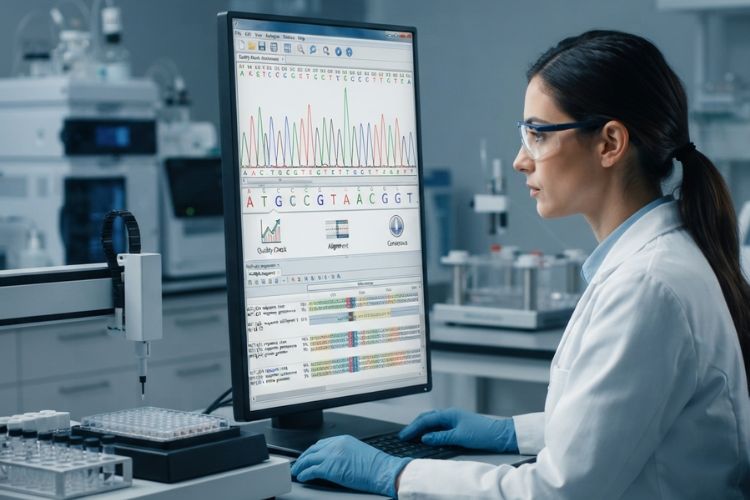
Knowing what peptide sequencing is does not mean every reported sequence should automatically be treated as certain. Researchers need to consider the quality of both the sample and the analytical evidence behind the assignment.
The selected peptide sequencing methods should suit the type of material being analyzed. Sample preparation, precursor mass accuracy, fragmentation quality, database selection, possible modifications, and ambiguous residues can all affect how confidently the final sequence is reported.
These checks are particularly important for peptide sequencing in research because later experiments may rely on the original characterization. Recognizing uncertainty at this stage can help researchers decide whether further testing or another analytical technique is appropriate.
Conclusion
Understanding what peptide sequencing is goes beyond reading a final string of amino acid letters. Researchers must consider how the sequence was generated, how much experimental evidence supports it, and whether any parts of the result remain uncertain.
Modern sequencing combines mass spectrometry, reference databases, de novo analysis, and other techniques to study peptides from different angles. When those results are considered alongside sample quality and experimental conditions, they can provide useful evidence for peptide characterization.
For researchers working with laboratory materials, accurate sequence information can support comparison, verification, and further study. Black Pearl Labs provides research-focused peptide materials and information for laboratory and scientific research applications.
FAQs
How accurate is peptide sequencing?
Accuracy can vary from one sample to another. Clear fragment signals and good sequence coverage make it easier to support an amino acid assignment, while weak signals, complex samples, or missing fragments can leave parts of a sequence uncertain.
Is peptide sequencing the same as protein sequencing?
No. Peptide sequencing focuses on determining the amino acid order of individual peptides. Protein analysis may involve breaking a larger protein into multiple peptides and using information from those smaller pieces to characterize the parent protein.
Can sequencing detect peptide modifications?
Mass spectrometry can detect mass changes that may suggest certain modifications. Fragment-ion data can sometimes help determine where a modification occurs, although the confidence of that assignment depends on the quality and completeness of the spectrum.
Can every amino acid be distinguished during peptide sequencing?
Not always. Some amino acids are difficult to tell apart using mass alone because they have the same or very similar masses. Researchers may need additional fragmentation data or another analytical approach when the available spectrum cannot clearly resolve a residue.