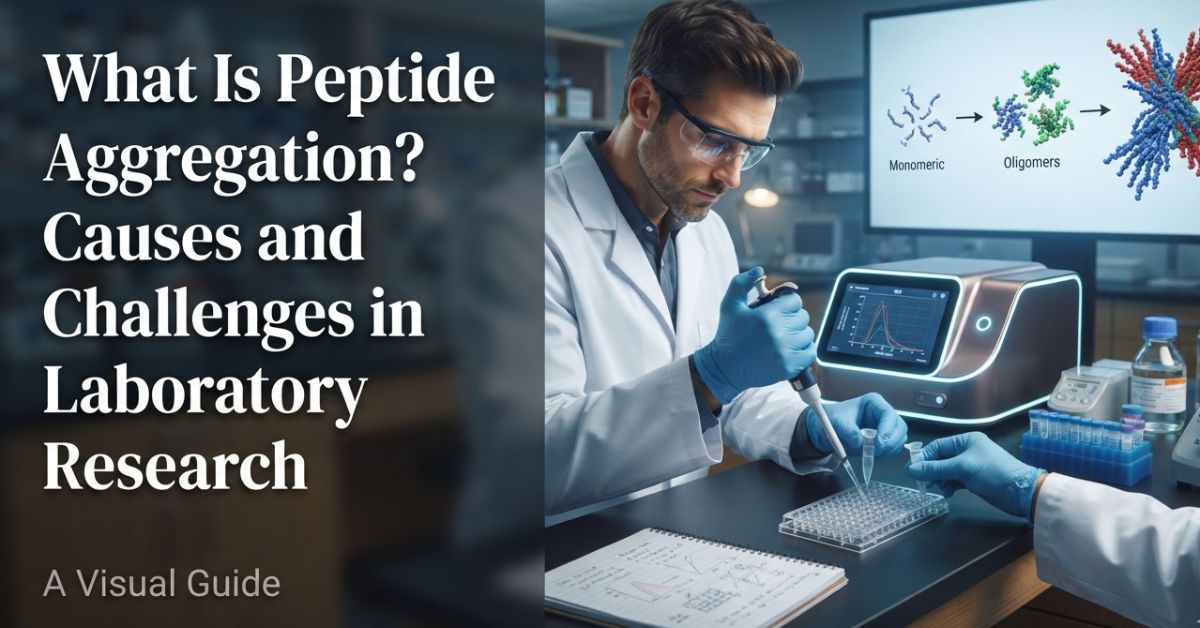
A peptide may behave as expected after synthesis, but that can change once it is dissolved or stored. The solution might become cloudy, small particles may appear, or the peptide may give different results after sitting for some time. Sometimes, nothing looks unusual at all.
This can happen because of peptide aggregation. Peptide molecules that were separate in solution can start sticking together and form larger groups. As more molecules join, less peptide may remain available in the form needed for the experiment.
For researchers working with peptides from Black Pearl Labs, knowing why these changes happen can make unusual results easier to understand. It can also help determine whether the problem comes from aggregation, poor solubility, chemical breakdown, or another change in the sample.
How Peptide Molecules Begin to Group Together
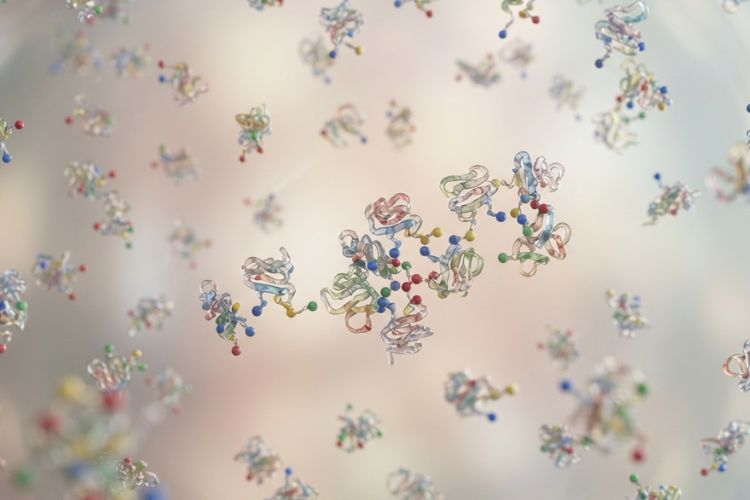
Peptides do not always stay separate once they are in solution. Some molecules begin to stick together, first forming small groups and sometimes building into larger structures or fibrils. In some cases, these groups can grow until part of the peptide no longer stays dissolved.
The way a peptide is built has a lot to do with this behavior. Hydrophobic parts of the peptide may come together to avoid contact with water, while hydrogen bonds can help hold nearby chains together. Certain peptide structures can make these interactions more likely.
Peptide aggregation also does not always mean that a visible precipitate will form. Small aggregates can remain in the solution without making it look cloudy. Precipitation happens when material becomes insoluble and separates from the solution.
Why Are Some Peptides More Prone to Aggregation?
Two peptides handled under similar laboratory conditions can behave very differently. Their amino acid composition, structural tendencies, concentration, and surrounding environment all influence how readily their molecules associate.
Amino Acid Composition Changes Molecular Interactions
Hydrophobic, charged, polar, and bulky amino acid residues interact differently with water and neighboring peptide molecules. Recent research into solid-phase peptide synthesis found that amino acid composition can be a strong predictor of aggregation during synthesis, rather than aggregation being determined only by exact sequence order.
This is especially relevant when researchers evaluate peptide synthesis impurities. Aggregation on the resin can interfere with normal synthesis chemistry and contribute to incomplete reactions, making the final crude material more difficult to purify and characterize.
Concentration and Structure Also Play a Role
As peptide concentration increases, molecules encounter one another more frequently. This can raise the chance of intermolecular association for an aggregation-prone peptide.
Secondary structural tendencies matter as well. Intermolecular hydrogen bonding and β-sheet-like structures can encourage molecules to assemble. However, there is no simple rule that every long or hydrophobic peptide will aggregate. The complete molecular and experimental environment has to be considered.
Why Aggregation During Synthesis Can Affect Peptide Quality
Aggregation is not limited to peptides that have already been dissolved. Peptide aggregation can also happen during solid-phase peptide synthesis, or SPPS, while the growing peptide chains are still attached to the resin. This can create problems before synthesis is complete.
When these chains start grouping together, reagents may have a harder time reaching parts of the peptide. As a result, coupling or deprotection may not proceed as expected. This can lead to deletion sequences, shortened peptides, or lower crude purity.
These unwanted products are one reason peptide impurity profiling is useful after synthesis. Aggregation is not the only source of impurities, so a purity percentage alone may not show everything present in a sample. Looking more closely at the sample can provide a better picture of its composition.
Researchers who buy research peptides can also review the purity and characterization information provided with the product. These details can help them choose material that fits the needs of their planned laboratory work.
What Can Happen After a Peptide Is Reconstituted
A peptide may come through synthesis without obvious problems but behave differently once it is dissolved. The solvent, pH, concentration, and temperature can all change how it behaves in the vial. Even the way the sample is handled or stored can make a difference.
Concentration is one factor to watch. In a concentrated stock, peptide molecules are closer together and have more chances to interact. Changes in pH can also change the peptide’s charge, making the molecules more or less likely to come together.
Why Aggregation Can Complicate Laboratory Results
The amount weighed into a vial is not always equal to the amount of monomeric peptide available during an assay. If some material has formed aggregates, the effective soluble concentration may differ from the concentration calculated during preparation.
That can become a problem in concentration-dependent experiments. Researchers may see unexpected activity, inconsistent replicates, or differences between freshly prepared and stored samples.
Peptide aggregation may also complicate interpretation because aggregation and chemical degradation are different processes. A peptide can associate without undergoing a change in its covalent chemical structure. Degradation, by contrast, can produce chemically modified species.
For researchers examining how Peptide Degradation Affects experimental performance, keeping these processes separate is important. Otherwise, a physical stability problem may be incorrectly treated as a chemical purity problem.
How Can Researchers Detect Peptide Aggregation?
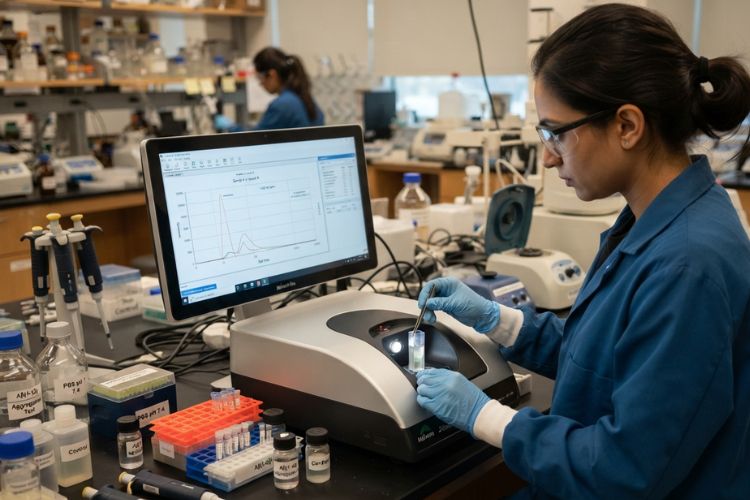
Visual inspection is useful when a sample becomes cloudy or develops visible precipitate, but appearance alone cannot confirm that a peptide remains monomeric. Smaller soluble aggregates may exist in a solution that still looks clear.
This is where analytical characterization of peptides becomes valuable. Depending on the sample and research question, techniques such as size-exclusion chromatography, dynamic light scattering, analytical ultracentrifugation, microscopy, or circular dichroism may provide information about molecular size, assemblies, or structural changes.
No single technique answers every question. Even analytical methods can influence weak non-covalent aggregates during measurement, so results should be interpreted in the context of the method used.
Tell Aggregation Apart From Other Sample Problems
A peptide that is difficult to work with is not necessarily aggregating. Similar changes can happen for different reasons, so it helps to look at what is happening to the sample before changing the preparation method. Solubility, chemical stability, and storage history can all offer useful clues.
Check Whether the Peptide Is Aggregating or Breaking Down
Poor solubility usually shows up when a peptide does not dissolve well in the first place. Aggregation is different because peptide molecules start joining together and may form larger groups. These changes are physical and do not necessarily mean that the peptide itself has chemically changed.
Chemical breakdown involves changes to the peptide molecule. Reactions such as oxidation, hydrolysis, or deamidation can produce peptide degradation products that are different from the original peptide. Peptide impurity profiling can help researchers find these unwanted forms and better understand what is in the sample.
Pay Attention to How the Sample Is Prepared and Stored
There is no single preparation method that works for every peptide. The risk of peptide aggregation can change with concentration, solvent, pH, temperature, and storage time. Looking at these details can help researchers find where a problem may have started.
Using a suitable solvent and buffer, avoiding overly concentrated stocks, and reducing unnecessary temperature changes may help with some peptides. Aliquoting can also limit repeated freeze-thaw cycles when the peptide is going to be used across several experiments.
It is also worth recording how each sample was prepared and stored. If results begin to change between experiments, those notes give researchers something practical to compare. Analytical characterization of peptides can then be used when a closer look at the sample is needed.
Conclusion
Peptide aggregation can develop at several points in a peptide’s laboratory life, from solid-phase synthesis to reconstitution, storage, and experimental use. Its behavior depends on the peptide itself as well as concentration, solvent, pH, temperature, ionic conditions, and handling.
Recognizing the difference between aggregation, poor solubility, precipitation, and chemical degradation can make troubleshooting more focused. Careful preparation, suitable storage, and appropriate analytical checks give researchers a clearer picture of the material they are actually working with.
FAQs
What are the first signs that a peptide may be aggregating?
Cloudiness, visible particles, or material settling in the vial can be signs of a problem. Changes in experimental results may also raise questions about the sample, even when there is nothing unusual to see.
Can a peptide aggregate even when the solution looks clear?
Yes. Small groups of peptide molecules may remain in solution without making it cloudy. This means appearance alone cannot confirm that all of the peptide is present as individual molecules.
Can storage conditions change how a peptide behaves?
Yes. Temperature changes, storage time, repeated freeze-thaw cycles, and the conditions used after reconstitution can affect some peptides. Keeping preparation and storage conditions consistent makes it easier to spot changes between samples.
Why can peptide aggregation affect research results?
Aggregation can change how much peptide remains available in the expected form. This may affect concentration-dependent experiments and can be one reason results differ between freshly prepared and stored samples.